
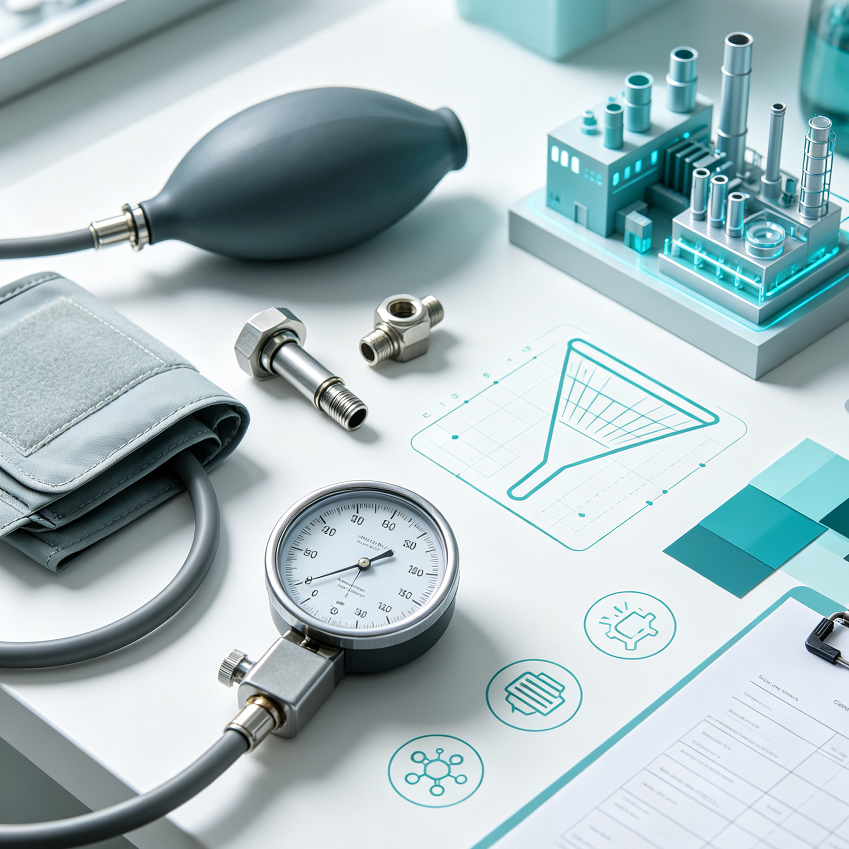
In the medical device supply chain, the sphygmomanometer bladder (and the inflation bulb) may be accessories, but they directly determine measurement accuracy and the end-user experience. For brand owners and medical device integrators, choosing a “reliable” OEM partner is the primary key to mitigating after-sales risks and enhancing market competitiveness.
Drawing from Fuli Rubber’s extensive experience as a source manufacturer in the medical rubber and plastic sector, we have outlined a practical screening logic for your next OEM partner.
I. Depth of Material Science Expertise
A blood pressure bladder is subjected to constant cycles of compression and deflation; the material is the foundation of its lifespan.
Compliance & Safety:
Can the factory provide natural rubber or medical-grade PVC that meets specific medical application requirements? Are they certified for RoHS and REACH? These are not just entry requirements—they are the baseline for brand safety.
Formulation R&D:
A reliable factory does more than just “process materials”—they possess formulation optimization capabilities. For instance, how does the bladder perform under extreme temperature fluctuations? How do they improve tensile fatigue strength for high-frequency clinical use? Fuli Rubber insists on “Idea-Driven Material Design,” customizing formulas to ensure products remain flexible and do not become sticky or brittle even after tens of thousands of uses.
II. Manufacturing Precision & Quality Governance
Most quality hazards in bladders, such as air leaks or uneven wall thickness, stem from crude manufacturing processes.
Mold Engineering:
Are the parting lines smooth? Is the interface free of flash? High-precision molds significantly reduce stress concentration points, thereby lowering the risk of rupture.
Integrated Molding Consistency:
Observe whether the factory uses integrated molding technology. Uniformity in wall thickness determines the linear expansion of the bladder during inflation, which is critical for the accuracy of blood pressure readings.
Airtightness Assurance:
A reliable factory must have the capacity for 100% airtightness testing, rather than just random sampling. Fuli Rubber has established a comprehensive pressure testing system to ensure every bladder leaving the facility is a “Zero Leakage” qualified product.
III. Efficiency in "Turning Ideas into Reality"
In our digital procurement practice, we find that many clients need more than just a standard part—they need innovation based on specific needs.
The Technical Consultant Role:
Can the factory provide clear engineering advice when you only have a vague concept (e.g., a “smoother touch” or “faster rebound”)?
Speed from 0 to 1:
What is the factory’s response cycle from initial concept and 3D modeling to rapid prototyping? A strong OEM partner is one that can help clients shorten the R&D cycle and reduce the cost of trial and error.
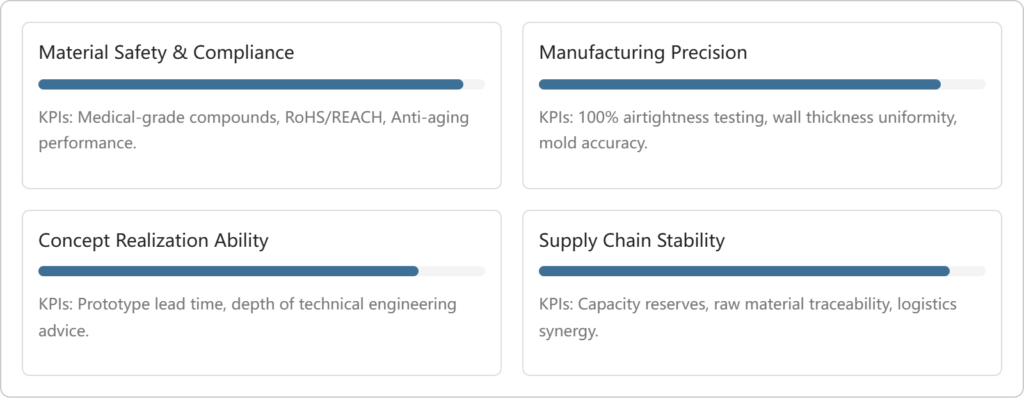
IV. Visualized Evaluation Model: Factory Screening Matrix
You can refer to the following matrix to score and evaluate potential suppliers:
Conclusion: Choose Fuli, Co-build Medical Quality
At Fuli Rubber, we believe that OEM customization is not just a simple addition of raw materials and labor; it is a chemical reaction of deep collaboration. We have earned the trust of global clients because we insist on a dual-track strategy of “Source Manufacturing + Deep Technical Service.”
Whether you need high-quality blood pressure bulbs and bladders or need to develop a completely new medical rubber component, Danyang Fuli Rubber & Plastic Co., Ltd. will safeguard your vision with the most rigorous quality standards and flexible technical support.
Fuli Rubber & Plastic: Making every pressure measurement precise and reliable.