
In the laboratory workbench, the toolboxes of digital repair shops, and the storage bags of photography enthusiasts, one can always find an unremarkable little item – the ear syringe.
It has a simple shape, yet with precise air flow control and flexible applicability, it has become an indispensable tool in multiple fields.
From its original medical use to its current multi-scenario applications, this small “rubber and plastic ball” carries the practical design wisdom, silently safeguarding precision equipment and the health of daily life.
Origin: From Medical Tools to Universal Cleaning Assistants
The ear cleaning ball, also known as an ear suction ball or dust blowing ball, was originally closely related to the medical field.
In the early days, it was mainly used in the ear, nose, and throat departments of hospitals to help clear pus, fluid, or residual water in the ear canal of patients, which was a basic instrument for maintaining ear health.
The core design logic of this device is straightforward: it utilizes elasticity to achieve changes in air pressure.
Through the directional outlet of the tube to guide the airflow or suction force, it completes the cleaning and extraction operations.
With the upgrading of industrial production and daily life needs, the uses of the ear cleaning ball gradually exceeded the medical boundaries.
Due to its oil-free, dust-free, controllable airflow, and non-damaging to precision components, it has been widely accepted in fields such as laboratories, digital repairs, and photography.
From a simple medical tool, it has evolved into a versatile cleaning assistant across various scenarios.
It has become a practical and useful item that is highly valued by tech enthusiasts and lovers.
Deconstruction: Scientific Principles in Simple Structures
The structure of the ear cleaning ball may seem simple, but it incorporates precise fluid dynamics design.
Its main body consists of two parts: the spherical elastic sac at the bottom and the slender exhaust tube at the top.
Some medical models are also designed to be detachable for easy cleaning and disinfection.
High-end products will add anti-slip ribs and a central reinforcement ring on the outer wall of the sac.
This not only prevents slipping during operation but also enhances the elastic rebound performance, ensuring the negative pressure suction effect.
Its working principle is based on the pressure difference and compressibility of gas: when the sac is squeezed, the internal space shrinks and the air is quickly expelled, forming a directional airflow.
After releasing the hand, the sac returns to its original shape by its elasticity.
The internal pressure is lower than the external atmospheric pressure, generating suction, allowing for liquid extraction or dirt adsorption.
The entire process does not require power supply and has no chemical residues.
The intensity of the airflow can be precisely controlled by the squeezing force.
This is the core advantage that enables it to be suitable for precise scenarios.
Material and Specifications: The Way to Make Choices for Different Scenarios
The performance differences of earphones mainly lie in the distinction of materials and specifications.
Different types are suitable for different usage scenarios, and when choosing, it is necessary to precisely match the requirements.
Material classification: A dual consideration of safety and durability
Currently, the main materials of ear cleaning balls available on the market are rubber, PVC and silicone.
Additionally, there are also environmentally friendly materials such as metal and bamboo as supplements, each with its own advantages and applicable scenarios.
- Natural rubber model: Laboratory standard material, featuring excellent corrosion resistance, anti-static property and anti-aging ability. It will not deform even when exposed to organic solvents such as ethanol and acetone for a long time. It can maintain elasticity after continuous extrusion hundreds of times, without cracks or odors, and is suitable for professional scenarios such as cleaning precision instruments and biological experiments.
- PVC model: A cost-effective option, with low price, suitable for daily office cleaning. For example, it can be used to dust off gaps in keyboards and mice, but its durability is poor. After repeated extrusion, it is prone to stickiness and aging, and is not suitable for precise scenarios.
- Silicone rubber model: The preferred material for medical use, safe and non-toxic, with low skin irritation and high biocompatibility. Suitable for sensitive individuals and medical scenarios. Its heat resistance and elasticity are superior to PVC. It is a choice that combines health and durability.
Specification selection: Capacity determines the applicable scope
The common sizes of the ear-cleaning balls are 25ml, 35ml and 65ml.
These are not just simple variations in size; they are tailored to different scenarios:
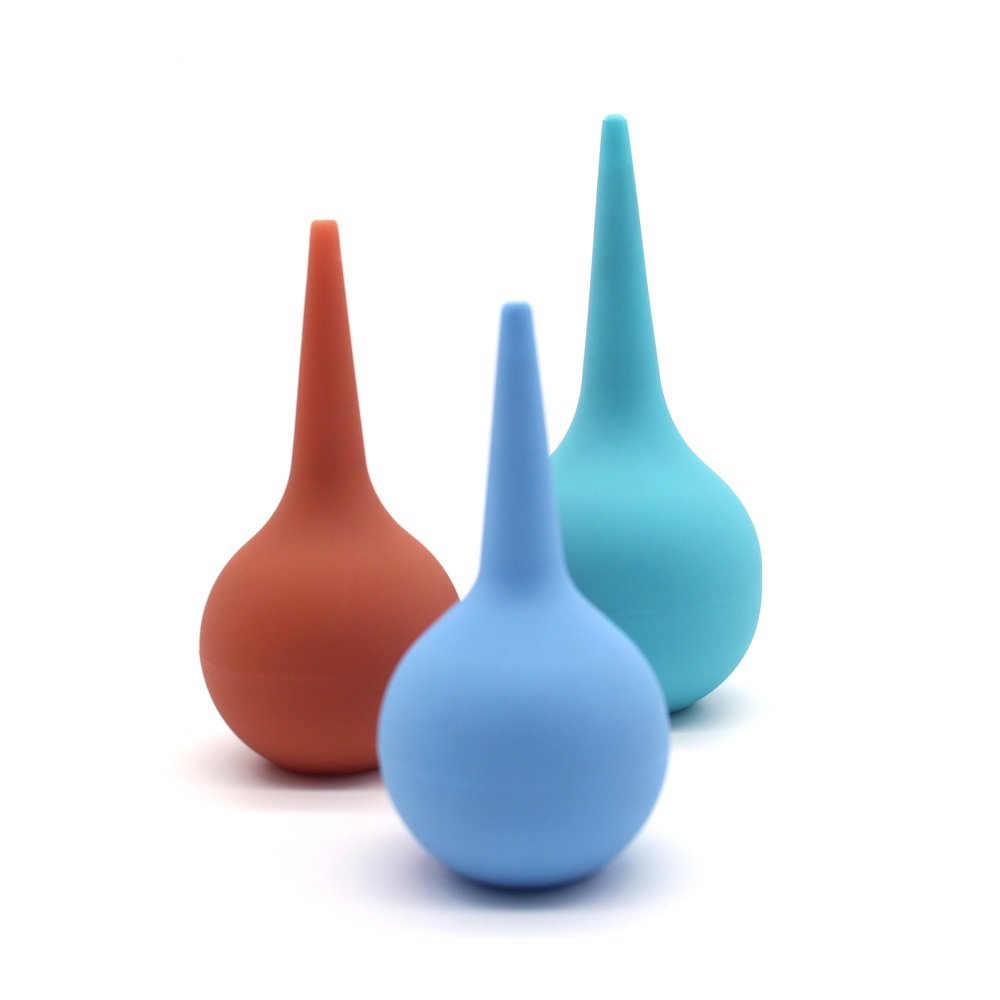
- 25ml Mini Model: Designed for small spaces, it delivers precise and short airflow. Suitable for narrow areas such as keyboard gaps, earphone mesh covers, USB interfaces, etc. It prevents dust from entering deeper and more precise component gaps.
- 35ml Gold Model: Balances precision and force, making it the most versatile specification. It can be used for laptop cooling grilles, router ventilation ports, camera lens surface cleaning, and has the highest adaptability in daily scenarios.
- 65ml Heavy Model: With strong pressure and air output, it is suitable for laboratory pipette blowing, optical lens dust removal, and cleaning the inner cavities of small electronic devices. It has no chemical residue and can be reused, being more economical and environmentally friendly than compressed air tanks.
Multifaceted Utility: Beyond Just Cleaning Value
Today’s ear-cleaning devices have long gone beyond the simple label of “cleaning”.
They have demonstrated practical value in various fields and have become hidden “efficiency tools”.
In the laboratory
It is an essential tool for pipetting operations, capable of precisely extracting liquids when used in conjunction with pipettes.
It can also disperse powdery substances in sealed containers to prevent contamination and waste.
Its oil-free and dust-free characteristics effectively protect experimental samples and instrument accuracy, making it an “invisible necessity” in analytical experiments.
In the digital and repair fields
It is the “protector” of precision components.
When cleaning motherboards and graphics card fans, the controllable airflow can thoroughly remove dust without introducing moisture and impurities like blowing with the mouth.
It also avoids the static damage that brushes may cause, extending the lifespan of the equipment.
In the photography and optical fields
The ear syringe is the preferred tool for lens cleaning.
The gentle airflow can blow away dust on the lens surface, preventing scratches during wiping.
When used with lens paper, it can maximize the protection of optical element performance.
In daily life
Its uses are also extensive: when repairing watches, it can clean the gaps of the movement, and when paired with alcohol, it can wipe metal parts.
It can also serve as a simple tool to help clean hard-to-reach areas such as printer nozzles and gap between glasses.
Safe Use and Maintenance: The Key to Longevity
The durability and safety of the ear cleaning ball depend on correct usage and maintenance.
Different scenarios require following corresponding guidelines:
When used for medical ear cleaning
It is necessary to check if the ball is damaged or clogged before use. Gently insert it into the outer ear canal, avoiding excessive force that could damage the eardrum.
After use, disassemble and clean it, dry it thoroughly to prevent microbial growth and infection.
If any damage occurs, it should be replaced immediately.
Do not attempt to use it under any circumstances.
When used for cleaning precision instruments
Avoid contact with acids, alkalis, oils, and organic solvents.
Keep it at least 1.5 meters away from heat sources to prevent material aging and deformation.
Before cleaning electronic devices, turn off the power to prevent static electricity and the airflow direction should avoid precise solder joints and circuits.
During daily maintenance
Store the ear cleaning ball in a dry and ventilated environment at 0-35℃ with a relative humidity of ≤80%.
Place it at a position 0.2 cm above the ground to avoid moisture and compression. Store it according to the guidelines.
The high-quality rubber model has an effective period of up to five years.
Evolution and Trends: From Traditional Tools to Intelligent Upgrades
From a simple ear-cleaning ball to a versatile practical tool across various fields.
The evolution history of the ear-cleaning ball is a vivid demonstration of pragmatic design.
It has no complex structure, yet it can solve core problems in details and create high value at low cost.
Whether it is precise operations in the laboratory, meticulous cleaning in the maintenance room, or small repairs in daily life, this small ear-cleaning ball, with its silent persistence, has become a reliable companion in our work and life.